
1、 Essence and purpose of testing
Definition of Current
Leakage current refers to the unexpected current formed between the live wire (L) and the neutral wire (N) due to defects in the insulation medium (such as aging and moisture) when the equipment is operating at rated voltage. The value is usually microampere level (μ A) 110.
Typical scenarios: standby state of household appliances, polarization process of insulation medium during the initial stage of equipment power on.
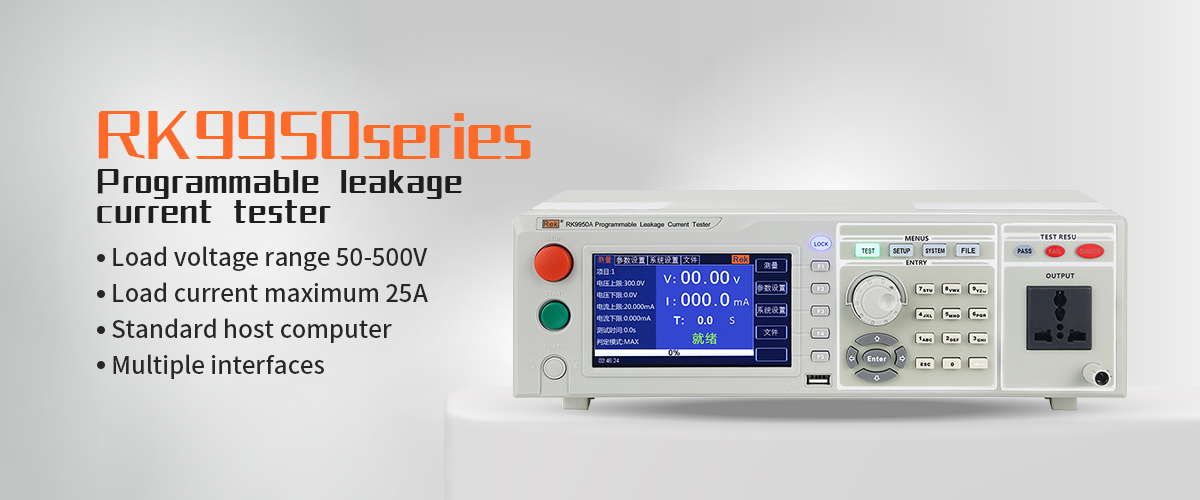
Detection target: by monitoring the current change between L and N, the overall moisture, deterioration or surface contamination of insulation can be judged to prevent breakdown accidents.
| Steps | Technical requirements |
| Wiring confirmation | Connect the L pole to the live wire, the N pole to the neutral wire, and the A pole to the equipment casing |
| testing voltage | Apply a 233.2V regulated power supply (rated voltage 110%) |
| stability time | After powering on, wait for 1-5 minutes until the current reading stabilizes |
| Measurement Object | Record the peak leakage current at the L-A or N-A end |
2、 Standard testing methods
Test equipment configuration
A dedicated leakage current tester should be used and operated according to the following specifications:
Voltage Application Object: Apply a test voltage (AC or DC) higher than the rated voltage to the L-N terminal
Measurement endpoints: The tester needs to be connected to the L pole, N pole, and the grounding terminal (A) of the equipment casing separately
Operation process (according to IEC/GB standards)
Key operational misconceptions
Incorrect operation: Directly measure the current between L-N (actual measurement needs to be indirectly measured through the grounding terminal of the shell)
Correct process: Only select the current of path L → A or N → A as valid data
3、 Comparison of different testing methods
According to industrial practice, there are three typical testing schemes:
| Scheme | Voltage setting | Stable time | Data validity |
| Viewpoint A (non-standard) | Random fluctuation of 220V mains power | Read at any time | Error>± 30% |
| Viewpoint B (partially valid) | 233.2V voltage stabilization | Read in 1 minute | Need to eliminate environmental interference |
| Viewpoint C (Standard) | 233.2V voltage stabilization | Read within 1-5 minutes | Only compliant reporting data |
4、 Technical points and error control
Measurement accuracy guarantee
Use shielded wires to connect the tester and avoid stray current interference
When the environmental humidity is greater than 80%, the infrared heating device needs to be activated to reduce the surface humidity of the test sample by 1
Safety limit reference
| Equipment type | Leakage current limit |
| Household Class I appliances | ≤0.75mA |
| Industrial motors | ≤0.5mA |
Analysis of L/N Line Differences
If the deviation between the L-pole and N-pole test results is greater than 20%, possible reasons may include:
Filter differential mode inductance impedance asymmetry
Unbalanced power load leads to abnormal current distribution
Core Summary
The leakage current testing of L and N poles must strictly follow the three elements of “voltage stabilization of 233.2V, 1-5 minute stabilization period, and L/N → A path measurement”. Its essence is to predict equipment safety risks by quantifying the small currents caused by insulation defects, including:
L → A current reflects the insulation status of the live wire to the shell
The current from N to A reflects the integrity of the zero line grounding
Dual path detection constitutes a dynamic monitoring system for electrical safety
Post time: Jul-07-2025


